Gary, Indiana
From Learners to Innovators: Hands-On STEM at McCullough Academy
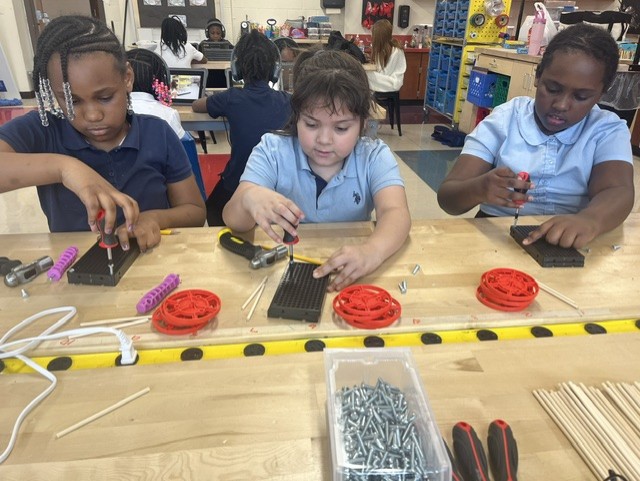
At McCullough Academy in Gary, Indiana, STEM learning is something students can see, touch, build, test, and improve. Through the school’s makerspace, students are moving beyond simply learning about STEM concepts and are putting those concepts into action through meaningful hands-on experiences.
Led by Principal Sharmayne McKinley and Rebecca McIntosh, Makerspace Manager and STEM teacher, the makerspace provides an environment where students are encouraged to explore their ideas, collaborate with classmates, solve problems, and discover what happens when their designs do not work the first time.
Most importantly, students are excited to be there.


Creating a New Kind of STEM Experience
For McIntosh, one of the greatest impacts of the makerspace has been the transformation she has seen in the way students approach STEM learning.
“Hands-on learning in the McCullough Academy makerspace looks like students who are actively engaged, excited, and eager to learn,” McIntosh shares. “The makerspace gives students the opportunity to move beyond simply listening to STEM concepts and instead experience, create, test, collaborate, and problem-solve.”
That shift from listening to doing gives students greater ownership of their learning. Rather than always being told exactly what to create or how to reach a solution, they have opportunities to design, experiment, and explore their own ideas.
McIntosh sees the difference in her students’ enthusiasm.
“They look forward to coming to STEM because they know they will have opportunities to create, explore, and try something new,” she explains.
That excitement does not end when STEM class is over. Students frequently arrive with their own ideas and suggestions for future projects, demonstrating that the makerspace is inspiring curiosity that extends beyond a single assignment.
“The makerspace has fostered a learning environment where students feel empowered to be creative, take risks, and see themselves as innovators.”
Putting the Engineering Design Process into Action
One project demonstrates what this type of hands-on learning can look like.
During a sailboat race car challenge, McCullough students designed and built cars and then created sails in different shapes and sizes. Using a fan to power their vehicles, students tested which sail designs allowed their cars to travel the fastest.
But the project did not end after the first test.
Students evaluated the results, determined what was and was not working, and redesigned their sails to improve performance. Through the process, they experienced the cycle of designing, testing, evaluating, and improving firsthand.
“What stood out most was the level of engagement, creativity, and collaboration,” McIntosh says. “Students eagerly talked with one another, shared ideas, and helped each other determine which sail designs worked best.”
The excitement of the race was only one part of the experience. Students were also practicing problem-solving, teamwork, perseverance, and critical thinking without those skills feeling separate from the learning.
“Watching their excitement as they tested, modified, and improved their designs was amazing,” McIntosh shares.
Expanding What Students Believe Is Possible
Having a dedicated makerspace has also opened the door to tools and technologies McCullough students did not previously have access to.
Students can now explore everything from hand tools and circuits to 3D printers and a Glowforge laser cutter. They have used those resources to create games, puzzles, mazes, and other projects that encourage them to turn their ideas into something tangible.
Access to these tools is important, but the real impact comes from what students learn while using them.
Every new tool presents an opportunity to ask questions. Every project introduces a new challenge. And every unsuccessful attempt provides a chance to rethink an idea and try again.
For McIntosh, helping students develop that mindset is one of the most important outcomes of the makerspace.
“I want students to understand that failure is part of the learning process and that when something does not work, they can make changes, try again, and find a solution.”


The McCullough Academy makerspace is not simply introducing students to STEM equipment. It is helping them develop confidence in their ability to solve problems, take risks, and tackle unfamiliar challenges.
Building Confidence Through Making
“Most importantly, the makerspace has increased students’ willingness to try new things and their excitement about STEM,” McIntosh explains.
Those qualities can stay with students long after a particular project is complete. The ability to think critically, collaborate with others, persevere when something does not work, and confidently approach a new problem are skills students can carry into future classrooms, careers, and everyday life.
At McCullough Academy, making gives students permission to wonder, experiment, fail, redesign, and ultimately succeed.
Through Rebecca McIntosh’s leadership and a learning environment built around exploration, McCullough students are discovering that STEM is not simply something they learn.
It is something they can do.